
Cash Flow Without Rigid Frameworks – Flexible Reporting for Capital Groups

CPM Consultant
4 min.
The cash flow report is ready, yet no one can explain where a specific operating item comes from. This is one of the most common challenges faced by CFOs and controllers in capital groups. Identifying cash operations – distinguishing operating cash flows from investing and financing activities, consolidation adjustments, or foreign exchange effects – requires not only a properly designed data model, but also a well-considered approach to the entire reporting process.
In practice, data for the cash flow statement usually comes from the general ledger, balance sheet accounts, adjustments, consolidation data, and information reported by multiple entities. Moreover, as organizations grow and evolve, data sources change as well. Managing these changes becomes a separate challenge in itself. In CPM systems such as OneStream, data is organized within a multidimensional model. This allows it to be managed flexibly for the purposes of consolidation and reporting across capital groups.
Table of Contents
The Most Common Challenges Organizations Face in Capital Group Reporting
Complex capital groups face many challenges related to reporting. The most common issues encountered by large organizations include:
- Many data sources: Cash flow is not created from a single report, but from a combination of accounting, balance sheet, consolidation, and adjustment data.
- Multiple entities within the group: Each entity may report differently, with varying levels of detail and within different process environments.
- Different charts of accounts and accounting practices: Similar business events may be recorded in different ways, making it difficult to consistently assign data to the cash flow statement. The mapping layer in CPM systems is designed specifically to organize such differences.
- Multiple currencies: Consolidation requires taking into account not only local data, but also currency translations and the impact of exchange rates on the final cash flow view.
- A large number of exceptions: The larger the organization, the more cases arise that do not fit into simple, universal rules.
- Difficulty in explaining changes: Cash flow reflects not only balances, but also changes in balances over time, so it is necessary to understand the source of a given change and how it should be classified. OneStream describes flow as a dimension that provides visibility into account movements and the context of changes between periods.
- High maintenance requirements: With a large number of entities, accounts, and organizational changes, the challenge lies not only in building the cash flow statement, but also in maintaining and developing it over time.
The most common challenges in cash flow reporting result from the growing complexity of data and the lack of a consistent processing model. To address these challenges and efficiently prepare cash flow reports, two key steps need to be taken.
Step 1: Account Balances Alone Are Not Enough for Cash Flow Analysis
At the flow level, the issue is quite fundamental: the ending balance alone says very little. To build a proper cash flow statement, it is necessary to understand what caused the change. Was it a business transaction, an adjustment, a reclassification, a consolidation-related change, or perhaps the result of currency translation effects?
This is where flow plays a key role. It allows data to be viewed not only from the perspective of the ending balance, but also from the perspective of the movements that led to that balance.
In practice, this provides several important benefits:
- Better understanding of account changes: It shows not only the value, but also the reason behind the change.
- Greater data transparency: It becomes easier to analyze what truly impacts cash flow.
- Better support for consolidation: Operational changes can be separated from adjustments, translations, or other group-level movements.
- Fewer simplifications and manual workarounds: Part of the logic is already captured at the data model level.
- A stronger foundation for further mapping: If flow is properly captured, building the cash flow report itself becomes much easier later on.
This is particularly important in large organizations. When a group includes multiple entities, different currencies, varying accounting practices, and a large number of exceptions, looking at balances alone is no longer sufficient. An additional layer of information is needed to show what type of movement actually took place.
This is a challenge for the organization itself – to prepare the data in an appropriate way, regardless of whether the source is accounting systems, properly configured system calculations, or manual adjustments entered by employees. OneStream enables the creation of an appropriate workflow that allows the organization to effectively manage the data collection process.
Step 2: Assigning Changes to the Appropriate Cash Flow Categories
If flow answers the question of what caused the change in an account, the next step is answering where that change should appear in the cash flow report. This is where tables managing the report structure begin to play a key role.
This approach primarily provides flexibility. The cash flow structure is not permanently embedded in the solution logic, but can instead be managed through properly designed tables. As a result, changes to the report layout, mappings, or presentation logic do not require rebuilding the entire mechanism each time.
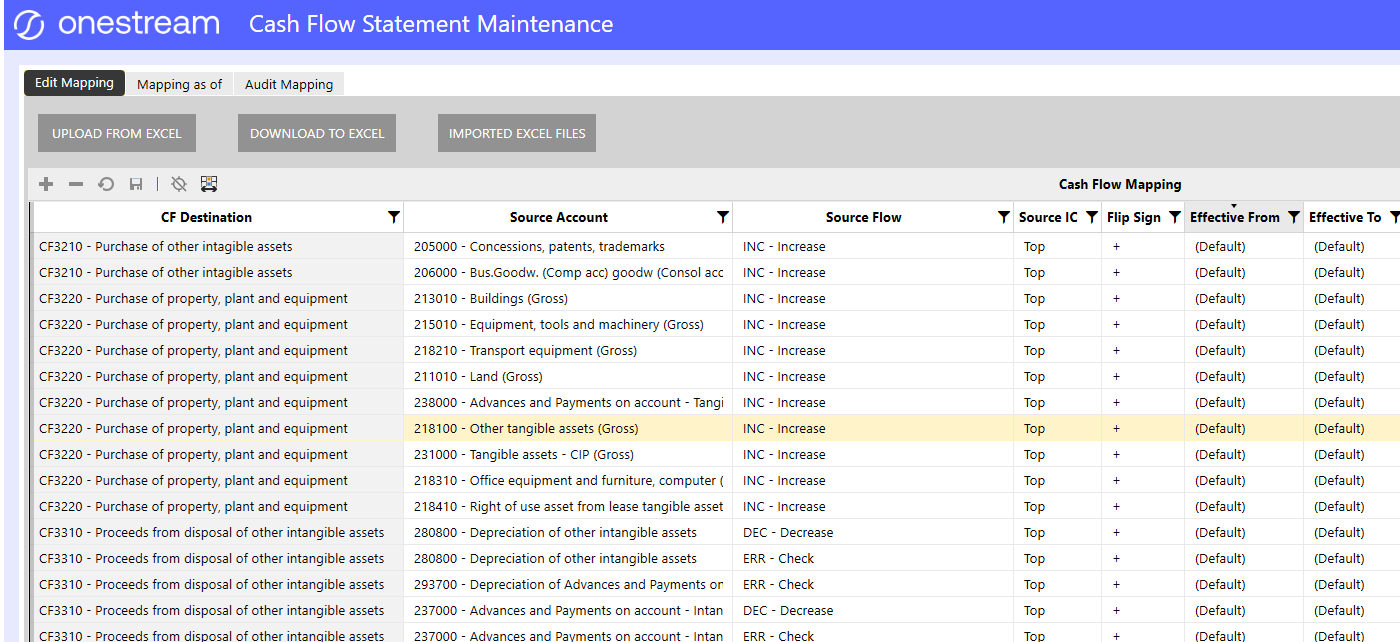
In practice, this means several very specific benefits:
- Easier management of the report structure: The cash flow layout and mappings to its categories can be controlled in one place.
- Ability to adapt over time: The solution handles organizational changes, new reporting requirements, or modifications to the report structure more effectively.
- Greater transparency: It becomes easier to understand the rules according to which data is assigned to specific cash flow lines.
- Less dependence on rigid technical logic: Many changes can be introduced through table management rather than by modifying the underlying mechanism itself.
- Better scalability: This approach works better in large organizations, where the number of accounts, exceptions, and changes grows over time and may vary across reporting periods.
It is worth emphasizing that this flexibility does not mean moving away from the data – quite the opposite. Such a solution remains strongly data-driven, as the input data continues to be the starting point for the entire process. The tables do not replace the source data, but rather create a management layer that makes it possible to organize the data and translate it into the final report structure.
This is an important distinction. On one hand, the report is not rigidly tied to a specific input structure, which provides greater flexibility and makes changes easier to implement. On the other hand, it still relies on actual financial data, flow, and business logic, ensuring consistency with the organization’s real financial picture.
As a result, the organization gains a solution that is simultaneously:
- flexible, because it can be expanded and adapted over time,
- stable, because it continues to rely on structured data,
- easier to maintain, because report management is handled through a transparent tabular layer.
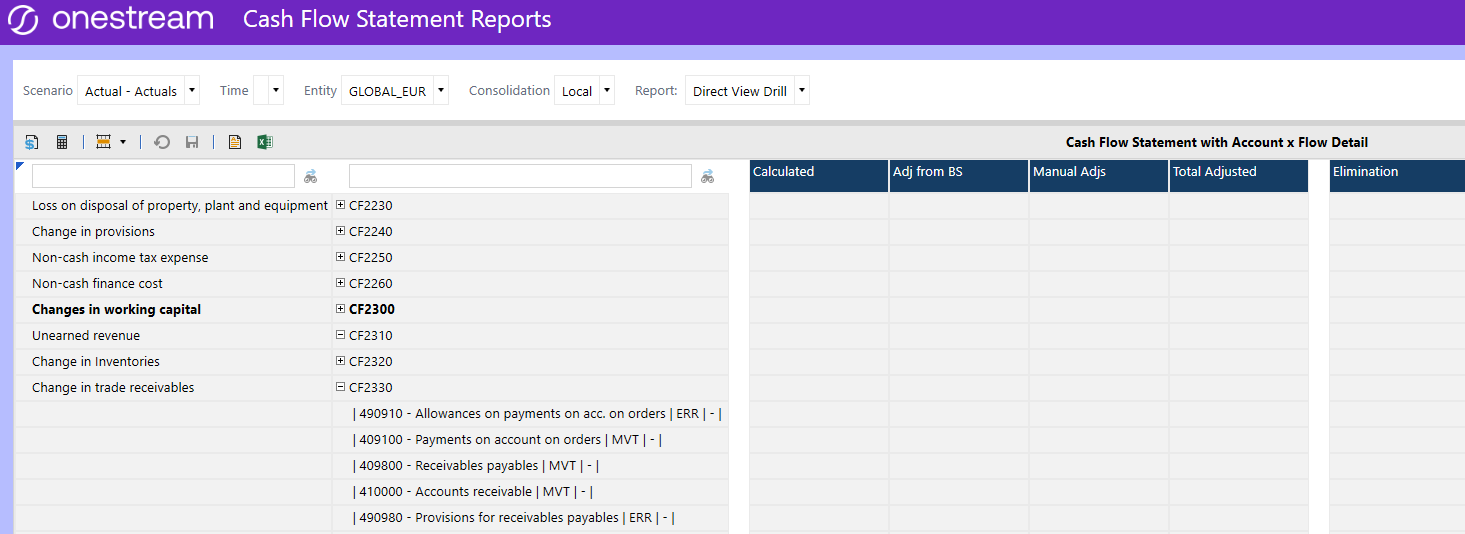
Tables are therefore not just a technical component of the solution, but a tool for consciously managing the cash flow report in a flexible, transparent, and sustainable way over time.
In practice, organizations that implement an approach based on flow and flexible mapping reduce the time needed to prepare reports and increase their reliability. This is the step that enables reporting to truly support management decision-making.
How to build a cash flow report in a capital group?
To build a proper cash flow report, it is necessary not only to aggregate data from different entities, but above all to understand the causes of changes (flow) and assign them to the appropriate report categories. The key is to combine source data with business logic and a consistent reporting model.
Why is analyzing balances alone not enough in cash flow reporting?
The ending balance only shows the result, but it does not explain what caused it. Without information about the reasons behind the changes, it is not possible to correctly classify cash flows or perform a reliable financial analysis.
How can data be assigned to the appropriate cash flow categories?
Assigning data requires a mapping layer that determines where a given change should appear within the report structure. In modern solutions, this is achieved through flexible tables or data models that allow the report logic to be managed without the need to rebuild the entire system.
What tools support cash flow reporting in capital groups?
Advanced CPM systems such as OneStream enable data integration, process automation, and the management of flow and mapping within a single model. As a result, reporting becomes faster, more transparent, and less prone to errors.
CONTACT
Let's talk about your project
Get in touch with us via this form, email, or phone. We’ll answer your questions, discuss the key challenges, and suggest initial solutions tailored to your needs.