
Line Item Planning in OneStream: From Aggregate to Detailed Planning

CPM Consultant
5 min.
Many organizations still rely on aggregate data for planning processes, such as department-level costs or revenue at the business unit level. While this approach is simple and quick to implement, it significantly limits visibility into what actually drives financial results. In practice, this makes analysis, forecasting, and informed decision-making much more difficult.
Table of Contents
Why Is Aggregate Planning No Longer Enough?
The limitations of aggregate planning become particularly apparent in more complex areas such as workforce planning, contract management, and CAPEX planning. In these cases, aggregate data fails to reflect business reality, while attempts to capture detailed information in Excel often result in errors, limited control, and poor scalability.
This raises a key question: is aggregate planning still sufficient to meet the needs of modern, dynamic organizations?
What Is Line Item Planning (LIM)?
Line Item Planning is an approach to planning based on individual records (line items) that represent specific business objects, such as employees, contracts, or projects. Instead of planning using aggregated values, organizations plan at the level of the individual elements that make up those totals.
In practice, each record contains a set of attributes and parameters (e.g., salary, start date, or region) that can be used in calculations. The model brings together data, business logic, and planning drivers within a single, integrated environment, providing full transparency and control over planning outcomes. As a result, organizations can move beyond high-level figures and gain a detailed, operational view of their planning processes.
How Does Line Item Planning Work in OneStream?
OneStream Line Item Modeling provides a structured approach to implementing this planning model. Its functionality can be explained through four key components.
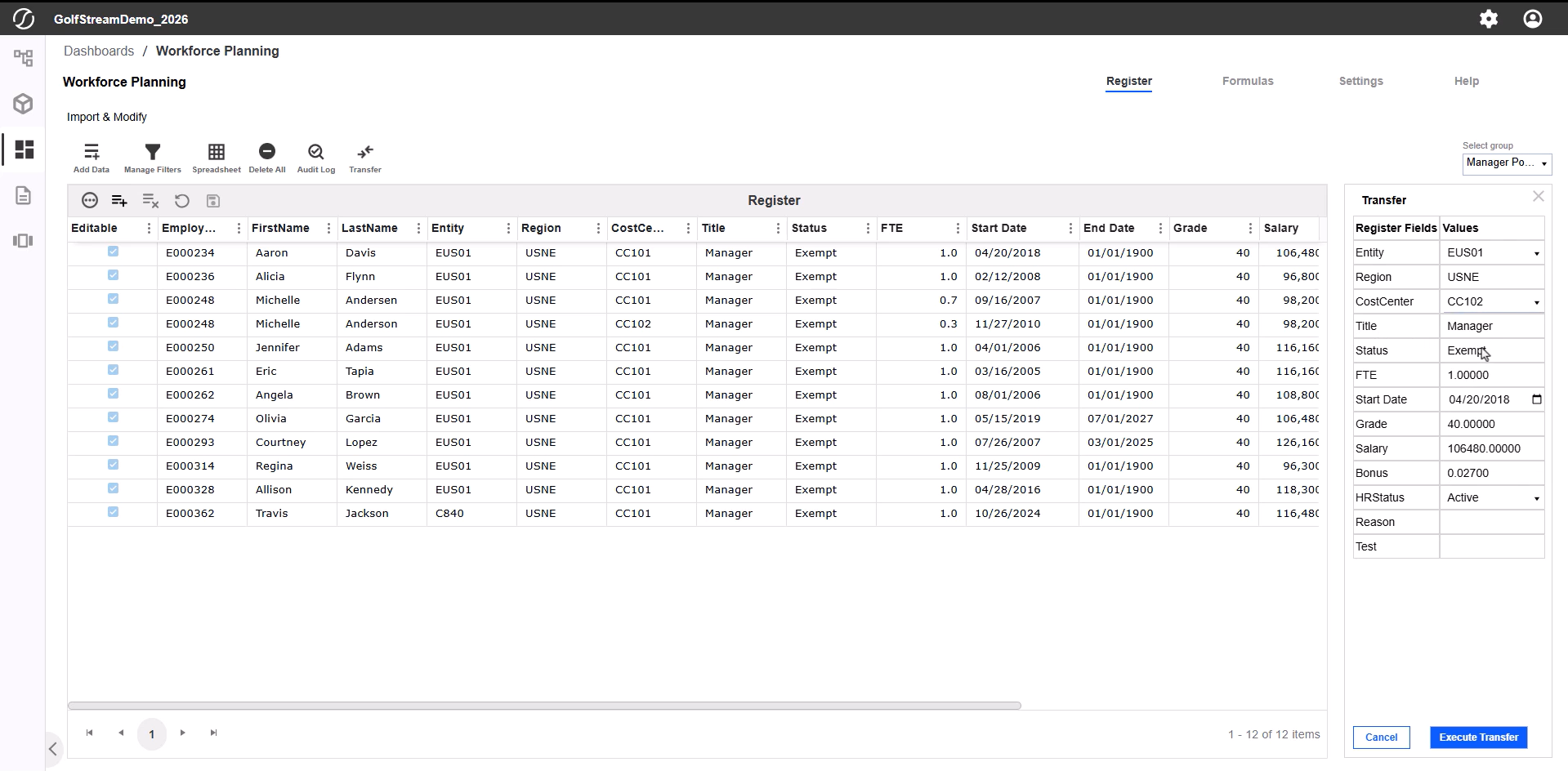
Register serves as the central data structure where detailed records are stored. This is where all line items and their attributes are defined.
Drivers are the values that drive calculations. They can be global (e.g., tax rates), sourced from the OneStream cube (e.g., exchange rates), or retrieved from lookup tables.
Formulas define the business logic. They determine calculation rules, relationships between data, and the conditions that influence planning results.
Plans represent the final output of the process—planning data that can be analyzed, reported on, and integrated with downstream business processes.
The entire process can be summarized in a simple flow: Data → Logic → Results.
Where Can Line Item Planning Be Applied in Practice?
OneStream Line Item Modeling can be applied wherever data variability and granularity are critical.
In Workforce Planning, it enables detailed planning of compensation, headcount, and employee turnover by taking into account the individual attributes of each employee. In CAPEX and Asset Planning, it supports modeling the entire asset lifecycle, including depreciation, capital investments, and asset retirement.
For Contract and Subscription Planning, it allows organizations to accurately model contract terms, contract durations, and their financial impact. In Project Planning, it supports planning for time-bound projects while reflecting changes in project timelines, costs, and other key variables.
What Are the Benefits of Line Item Planning?
The greatest benefit of Line Item Planning is the significant increase in transparency and control over planning data. Organizations gain a clear understanding of what drives financial results and which factors influence them.
With a driver-based approach, organizations can create more accurate forecasts and respond more quickly to changing business conditions. Line Item Modeling also enables what-if scenario analysis, helping organizations prepare for different business outcomes and make more informed decisions.
Another key advantage is the automation of planning processes and a reduced reliance on Excel. This leads to greater data consistency, improved governance, and a lower risk of errors. As a result, organizations are better equipped to support confident, data-driven decision-making.
Line Item Planning vs. Aggregate Planning
In the traditional approach, planning is based on aggregated data, which limits flexibility and analytical capabilities. Running scenario analyses is often difficult, and Excel typically becomes the primary planning tool.
With Line Item Modeling, planning is based on detailed data, providing greater flexibility and support for advanced planning scenarios. Because it is fully integrated with OneStream, organizations benefit from consistent business data, stronger governance, and a scalable planning solution.
When Is Line Item Modeling Not the Right Choice?
Although Line Item Planning offers many benefits, it is not always the best solution. For relatively simple planning models, its implementation may not be justified. The same applies when an organization does not have access to detailed input data or does not require advanced scenario planning capabilities.
In these situations, implementing Line Item Modeling may introduce unnecessary complexity that exceeds actual business requirements.
How Is Line Item Planning Implemented?
The implementation of OneStream Line Item Modeling begins with an assessment of business requirements and the identification of planning areas where greater data granularity will deliver the most value.
The next step is to design the planning model, including the Register structure, planning drivers, and business logic defined through formulas. This is followed by system configuration and integration with existing data sources.
After testing and validation, end users are trained before the solution is deployed into the production environment.
When Should You Implement Line Item Planning?
OneStream Line Item Modeling enables organizations to move beyond static reporting toward active business planning and decision-making. By planning at the level of detailed records, organizations gain greater visibility, flexibility, and the ability to respond quickly to changing business conditions.
This approach is particularly valuable for organizations operating in dynamic, fast-growing, or complex business environments, where detailed planning can deliver a significant competitive advantage.
How does Line Item Planning differ from aggregate planning?
Aggregate planning is based on summarized values, whereas Line Item Planning enables planning and analysis at the level of individual business records. This provides greater accuracy, transparency, and control over the planning process.
What are the applications of Line Item Planning?
Line Item Planning is most commonly used for workforce planning, CAPEX planning, contract and subscription planning, and project planning.
Is Line Item Planning scalable?
Yes. It is particularly well suited to large, dynamic organizations where planning involves high volumes of data and constantly changing business processes.
CONTACT
Let's talk about your project
Get in touch with us via this form, email, or phone. We’ll answer your questions, discuss the key challenges, and suggest initial solutions tailored to your needs.