
From Numbers to Strategy – How AI Strengthens the CFO’s Role

CPM Consultant
7 min.
The role of the Chief Financial Officer has evolved far beyond traditional accounting and budgeting. Today’s CFO is a strategic business partner who analyzes data in real time, anticipates market trends, and makes decisions based on robust forecasts. In this context, artificial intelligence becomes an invaluable enabler, supporting more efficient financial management.
Key competencies of today’s CFO include analytical thinking and the ability to interpret financial data, a deep understanding of business strategy, and the capability to translate numbers into clear, actionable recommendations for the executive team. Equally important are strong communication and leadership skills – the CFO must effectively collaborate across departments, with investors, and with board members. In a dynamic business environment, decision-making agility and growing technological proficiency are also essential, particularly in the area of EPM systems and advanced data analytics.
Financial leaders must combine analytical capabilities with business intuition, turning raw data into actionable insights. Their impact extends far beyond the finance function – they often help shape the strategic direction of the entire organization, leveraging increasingly advanced digital tools to optimize processes and drive profitability.
Table of Contents
What can AI take off the CFO’s plate?
Artificial intelligence can significantly reduce the workload of CFOs and finance teams across key areas of operations. Here are the main areas of support:
- Automation of budgeting and forecasting processes: AI analyzes large volumes of historical data and predicts future financial results with high accuracy. Machine learning algorithms identify patterns that may not be visible to human analysts, enabling more precise forecasts and more effective risk management.
- Enhancement of financial and management reporting: AI automatically generates reports and dashboards by aggregating data from multiple sources. As a result, the CFO can focus on analysis and strategic decision-making instead of spending time on manual document preparation.
- Cost optimization and FinOps: AI conducts in-depth analysis of cost structures, identifying areas of potential savings. It also supports the management of IT and cloud infrastructure costs, which is crucial in FinOps strategies.
- Financial modeling and scenario analysis: Advanced algorithms simulate various financial scenarios, supporting the CFO in strategic decisions related to investments, mergers, acquisitions, or restructuring. The ability to anticipate the impact of different scenarios helps minimize business risk.
- Financial consolidation and regulatory compliance: AI automatically reconciles and consolidates financial data from multiple organizational units, ensuring compliance with accounting and tax regulations. It also detects anomalies and potential errors, improving reporting quality and compliance.
AI technology not only automates routine tasks but also significantly enhances the quality of financial analysis. Thanks to its ability to process vast amounts of data, it can identify efficiency opportunities that might otherwise be overlooked. Automated financial consolidation eliminates the risk of human error and ensures data consistency across the organization, translating into better business decisions and increased investor confidence.
AI Technologies Changing the Way Finance Teams Work
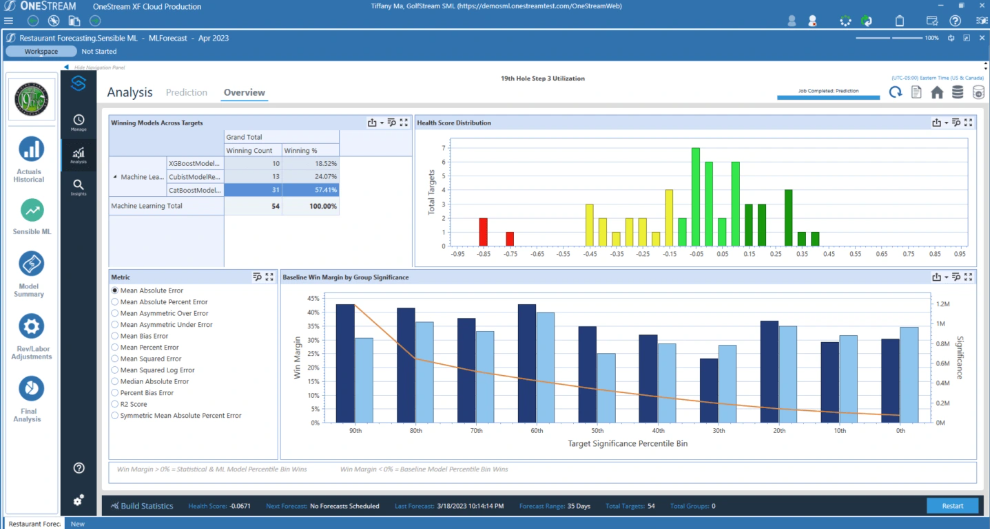
An example of an advanced AI solution supporting CFOs in these areas is OneStream Sensible ML. This technology enables the creation of highly accurate forecasts based on time series data provided by users. In the context of strategic planning, organizations can leverage 3- to even 5-year historical datasets to build long-term forecasts that support defining the company’s strategic direction. Sensible ML analyzes 60 monthly data points and creates statistical forecasting models (univariate), which can be deployed within the OneStream environment.
In operational planning and annual budgeting, where financial targets need to be translated from a high-level view into detailed plans across product categories, sales channels, or customer segments, Sensible ML can process 150–250 monthly data points. The technology automatically enriches source data with macroeconomic factors, generates features relevant for modeling, selects the most impactful variables, and compares predictive models (e.g., ARIMA, SARIMA) to ultimately deploy the most effective forecasting approach.
In more advanced use cases, such as daily or weekly demand planning or S&OP, Sensible ML can process over 250 data points, integrating internal and external data, and incorporating business events, promotions, and holidays through an event builder. This enables the creation of highly granular forecasts for specific products and locations, supporting decision-making in logistics, procurement, workforce management, and inventory planning.
Another solution worth noting in the context of supporting CFOs is the IBM watsonx™ platform. It consists of three main components: watsonx.ai, watsonx.data, and watsonx.governance. Watsonx.ai enables the development and deployment of advanced predictive and language models that can support financial forecasting, risk analysis, and the preparation of strategic recommendations. For CFOs, this means the ability to automatically generate accurate analyses based on historical data, significantly accelerating the decision-making process.
In turn, watsonx.data is a solution that facilitates the collection, processing, and analysis of large volumes of financial data from multiple sources, including ERP systems and data warehouses. This supports data centralization and enables better control over both management and operational reporting. Meanwhile, watsonx.governance allows for comprehensive monitoring and documentation of AI model performance, which is particularly important in the context of regulatory compliance and the auditability of AI-driven decisions.
AI as a Strategic Partner to the CFO
Artificial intelligence does not replace the CFO, but rather serves as a powerful support that allows them to focus on the most critical aspects of financial management. With the help of technology, finance leaders can identify risks more quickly, manage KPIs more effectively, and increase the accuracy of their decision-making. AI eliminates many time-consuming processes, yet it is still the human who remains responsible for strategic direction and the interpretation of results.
The adoption of AI in finance is not just a trend, but a key step toward greater efficiency and competitiveness. CFOs who actively implement new technologies gain not only increased control over their organization’s financial landscape, but also the ability to better adapt to changing market conditions.
CONTACT
Let's talk about your project
Get in touch with us via this form, email, or phone. We’ll answer your questions, discuss the key challenges, and suggest initial solutions tailored to your needs.